Tangel Agro

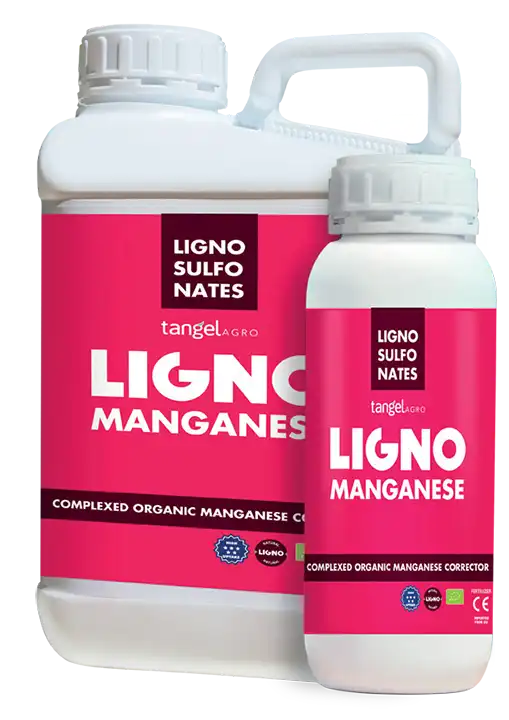
Ligno Mn

Ligno Mn

Highly Available Manganese Complexed with Natural Lignosulfonic Acid for Fast, Efficient Crop Nutrition

LIGNO Mn is a liquid manganese deficiency corrector formulated with 10% w/w manganese complexed by lignosulfonic acid, a natural chelating and complexing agent derived from lignin. Its highly soluble formulation keeps manganese in an available form, promoting efficient absorption and a rapid nutritional response after foliar or soil application.

The lignosulfonate complex provides high stability and helps distribute manganese evenly across the leaf surface. Its naturally low surface tension and hygroscopic properties support nutrient diffusion and penetration, including under relatively low-humidity conditions. By improving manganese availability, LIGNO Mn supports chlorophyll formation, photosynthesis, enzyme activation, nitrogen use, protein synthesis, germination, tillering, flowering and the development of healthy green tissues.

The product is suitable for preventing and correcting manganese deficiency in cereals, rice, maize, potatoes, legumes, oilseed crops, fruit crops, grapevines, tobacco, cotton and ornamental plants.

Composition and Guaranteed Analysis

Composition

%w/w

Citrus essential oils (Limonene)

7,00

Inert ingredients

93,00

Composition%w/w
Manganese (Mn)10.0
Natural Chelating Agent (Lignosulfonic Acid)

Origin and Certifications

LIGNO Mn is based on lignosulfonic acid, a natural lignin-derived biopolymer used as a complexing agent for micronutrients. This natural carrier increases manganese stability and helps maintain the nutrient in a water-soluble and plant-available form.

The product datasheet presents LIGNO Mn as a natural fertilizer and displays CE identification. Registration, certification status and permitted claims may vary depending on the destination market, so local agricultural regulations and the approved product label should always be consulted before use.

Composition

  • Manganese (Mn): 10.0% w/w
  • Complexing agent: natural lignosulfonic acid
  • Formulation: highly soluble liquid
  • Application: foliar and soil

LIGNO Mn combines manganese correction with the agronomic advantages of a natural lignosulfonate carrier. Its multiple benefits include:

  • Prevention and correction of manganese deficiency.
  • Improved chlorophyll synthesis and maintenance of green leaf tissue.
  • Support for photosynthetic activity and water-splitting reactions.
  • Activation of enzymes involved in plant metabolism.
  • More efficient use of available nitrogen.
  • Support for protein synthesis, growth and biomass formation.
  • Improved early germination and seedling development.
  • Better tillering, flowering and inflorescence quality.
  • Greater crop vitality during cold conditions.
  • Increased tolerance to low temperatures and frost.
  • Support for crop quality, yield and maturity.
  • Improved availability and nutritional interaction with phosphorus and calcium.

Rapid Manganese Correction

The highly soluble formulation supplies manganese in an assimilable form, helping crops respond quickly when deficiency symptoms or nutritional limitations appear.

Supports Photosynthesis and Greener Leaves

Manganese participates in chlorophyll formation and essential photosynthetic processes. Adequate manganese nutrition helps maintain healthy green leaves and productive photosynthetic tissues.

Improves Nitrogen Efficiency

LIGNO Mn supports enzymatic processes associated with nitrogen metabolism, helping plants use available nitrogen more efficiently for protein synthesis, growth and biomass production.

Promotes Tillering and Crop Establishment

Manganese contributes to germination, early development and tiller formation, making LIGNO Mn especially valuable in cereals and rice during the first vegetative stages.

Reinforces Plant Vitality

Correct manganese nutrition supports stronger stems, better vegetative development and improved crop performance during periods of low temperature or other challenging growing conditions.

Supports Flowering and Reproductive Development

Applications can contribute to healthier flowers, inflorescences and reproductive tissues, particularly when manganese availability is limited.

  • Natural complexing technology: manganese is complexed with lignosulfonic acid derived from lignin.
  • High solubility: keeps manganese available for foliar absorption and soil uptake.
  • Stable nutrient complex: reduces the risk of manganese becoming rapidly unavailable after application.
  • Low surface tension: encourages better distribution of the spray solution across leaves.
  • Hygroscopic properties: help retain moisture around deposited nutrients and support leaf penetration under low-humidity conditions.
  • Efficient leaf coverage: promotes more homogeneous micronutrient distribution.
  • Fast crop response: suitable for preventive programmes and the correction of visible or suspected manganese deficiency.
  • Flexible application: suitable for foliar and soil use across a broad range of crops.
  • Tank-mix versatility: compatible with most pesticides and fertilizers, subject to a prior compatibility test.
  • Convenient formats: available in 1 L, 5 L, 10 L, 20 L and 1,000 L packaging.

Dosage & applications

CROPSASSOCIATESMAXIMUM Nº OF TREATMENTSLAST MOMENT OF APPLICATIONSPRAYING EQUIPMENT
All crops2–4 L/ha in at least 200 L of waterMultiple applications, as requiredWhen requiredFoliar spray / soil application
Cereals1–3 L/ha4From the 3-leaf stageFoliar spray
Potatoes1–3 L/ha4From the 6-leaf stageFoliar spray
Legumes1–3 L/ha3From the 6-leaf stageFoliar spray
Maize1–3 L/ha2From the 4-leaf stageFoliar spray
Oilseed rape1–3 L/ha3From the 4-leaf stageFoliar spray
Sunflower1–3 L/haAs requiredFrom the 4-leaf stageFoliar spray
Pome fruit1–3 L/ha4From red bud until harvestFoliar spray
Soft fruit1–3 L/ha3From the start of shoot growthFoliar spray
Citrus fruit2 L/ha3From white bud until harvestFoliar spray
Wine grapes2 L/ha3From visible inflorescencesFoliar spray
Tobacco2 L/ha3From the 4-leaf stageFoliar spray
Ornamental plants2 L/ha2Once sufficient leaf mass has developedFoliar spray
Cotton2–4 L/ha3From the 4-leaf stageFoliar spray
Rice2–4 L/ha5From the 3-leaf stageFoliar spray

CROPS

ASSOCIATES

MAXIMUM Nº OF TREATMENTS

LAST MOMENT OF APPLICATION

SPRAYING EQUIPMENT

All crops

All approved agrochemicals

Follow the conditions established for the use of the associated agrochemical.

Follow the conditions established for the use of the associated agrochemical.

Suitable for use in various application techniques: Full coverage application, low volume concentrate, spray, pivot, and spray.

Vegetative nutrition

Authorized uses, rate and times of application

CROPSPRODUCT TYPESADJUVANT FUNCTIONWETTA FINAL CONCENTRATION
Liquid manganese micronutrient fertilizer complexed with lignosulfonic acidPrevention and correction of manganese deficiencyManganese (Mn): 10.0% w/w

GENERAL DOSE: Foliar application: Apply 2–4 L/ha diluted in at least 200 L of water per hectare. Repeat according to crop requirements, manganese status and the severity of the deficiency. Follow the crop-specific rates and application timings indicated in the application table. Soil application: Adjust the dose according to crop requirements, soil characteristics, irrigation conditions and analytical results. Apply preventively in crops with a known risk of manganese deficiency or correctively when symptoms appear. LIGNO Mn is compatible with most fertilizers and plant protection products; however, a jar compatibility test is recommended before preparing previously untested tank mixtures.

CROPS

PRODUCT TYPES

ADJUVANT FUNCTION

WETTA FINAL CONCENTRATION

All crops

Insecticides, Fungicides, Acaricides, Herbicides, Protection, Plant Growth Regulators, Foliar Fertilizers, Biostimulants

Dispersion and wetting

0,05-0,15% V/V

Dispersion, Wetting + Anti-rebound, Rewetting, deposition

>0,15->0,25% V/V

Dispersion, wetting + anti-rebound, rewetting, deposition + penetration

0,25 – 0,30% V/V

Features and Properties

LIGNO Mn is a highly soluble liquid manganese corrector containing 10% w/w manganese. Its liquid formulation facilitates dilution, tank preparation and homogeneous application through conventional foliar or soil nutrition systems.

The manganese is complexed with natural lignosulfonic acid. This complexing agent helps maintain the micronutrient in a stable and water-soluble form, improving its availability for plant uptake and limiting rapid nutrient immobilisation.

Lignosulfonates are hygroscopic biopolymers derived from lignin. Their ability to retain moisture around nutrient deposits can support manganese diffusion and penetration through the leaf surface, even when atmospheric humidity is relatively low.

The formulation also has naturally low surface tension. This characteristic promotes better spreading of the spray droplets and more uniform coverage of the treated leaf area, increasing contact between the nutrient solution and plant tissues.

Once absorbed, manganese contributes to several essential physiological processes. It activates numerous enzymes, participates in photosynthetic water-splitting reactions, supports chlorophyll synthesis and contributes to nitrogen metabolism and protein formation.

Adequate manganese nutrition also supports seed development, germination, early crop establishment, flowering, tillering and maturity. These functions are especially important in cereals and rice, where manganese availability can influence vegetative vigour, tiller development and stem stability.

Recommended Crops and Timing of Application

Cereals and Rice

Apply from the 3-leaf stage, particularly in fields with a history of manganese deficiency, high-pH soils or conditions that reduce micronutrient availability. Treatments support tillering, nitrogen efficiency, stem stability, vitality and winter hardiness.

Maize

Begin treatments from the 4-leaf stage. Early applications are particularly useful when cool soil conditions restrict root activity and manganese uptake.

Potatoes

Apply from the 6-leaf stage to support vegetative vitality, nitrogen efficiency and tuber skin quality.

Legumes

Begin from the 6-leaf stage, especially where cold conditions, restricted root activity or low manganese availability affect crop vitality.

Oilseed Rape and Sunflower

Apply from the 4-leaf stage. Programmes may support crop vigour, oil production and, in oilseed rape, winter hardiness.

Pome Fruit

Apply from red bud through to harvest, according to nutritional requirements. Treatments may support leaf activity, crop vitality and fruit colour development.

Soft Fruit

Begin at the start of shoot growth to support healthy foliage, nitrogen efficiency and vegetative vitality.

Citrus Fruit

Apply from white bud until harvest, adjusting the number of treatments to crop demand and leaf analysis.

Wine Grapes

Begin when inflorescences become visible. Repeat applications may support canopy vitality and manganese nutrition through important reproductive stages.

Tobacco and Cotton

Apply from the 4-leaf stage, especially when cold conditions limit early vegetative growth or nutrient uptake.

Ornamental Plants

Apply once plants have developed sufficient leaf mass to intercept and absorb the foliar spray effectively.

FAQ

What is LIGNO Mn?

LIGNO Mn is a highly soluble liquid fertilizer containing 10% w/w manganese complexed with natural lignosulfonic acid. It is designed to prevent and correct manganese deficiency in agricultural and ornamental crops.

What does manganese do in plants?

Manganese activates several enzymes and participates in chlorophyll synthesis, photosynthesis, nitrogen metabolism, protein formation, germination, tillering and reproductive development.

What are the typical symptoms of manganese deficiency?

Common symptoms include interveinal chlorosis, pale or mottled leaves, reduced photosynthetic activity, weak growth, poor tillering and lower crop vitality. Symptoms and their distribution vary by crop.

Can LIGNO Mn be used preventively?

Yes. Preventive applications are recommended in crops or soils with a known risk of manganese deficiency. Early treatment helps maintain adequate manganese nutrition before visible symptoms reduce crop performance.

Can it be applied as a corrective treatment?

Yes. Its highly soluble and stable formulation is suitable for rapid nutritional correction when manganese deficiency symptoms appear or when tissue analysis indicates insufficient manganese.

Is LIGNO Mn suitable for foliar application?

Yes. The lignosulfonate carrier promotes spreading, moisture retention and nutrient contact with the leaf surface. For general foliar use, apply 2–4 L/ha in at least 200 L of water.

Can it also be applied to the soil?

Yes. The datasheet identifies LIGNO Mn for both foliar and soil use. Soil rates should be adapted to crop requirements, soil characteristics, irrigation conditions and analytical results.

Why is lignosulfonic acid used in the formulation?

Lignosulfonic acid acts as a natural complexing agent. It stabilises manganese, helps keep it water-soluble and supports more efficient distribution and absorption.

Is LIGNO Mn compatible with other agricultural inputs?

It is compatible with most fertilizers and pesticides. A jar test should be performed before preparing any tank mixture that has not previously been tested.

When should treatments begin?

Timing depends on the crop. For example, applications can begin from the 3-leaf stage in cereals and rice, the 4-leaf stage in maize and oilseed crops, the 6-leaf stage in potatoes and legumes, red bud in pome fruit and visible inflorescences in wine grapes.

How many applications are recommended?

Depending on the crop, the programme may include between one and five applications. The number of treatments should be adjusted to crop demand, deficiency severity, growing conditions and the specific recommendations in the technical table.

Can LIGNO Mn be used in all crops?

Yes. The general recommendation covers all crops, while the datasheet also provides specific programmes for cereals, potatoes, legumes, maize, oilseed rape, sunflower, fruit crops, grapevines, tobacco, ornamental plants, cotton and rice.

Become our distributor

Fill out the form to obtain information about the distributors closest to your zip code.

tangel agro