Product Type
Organic zinc complex corrector

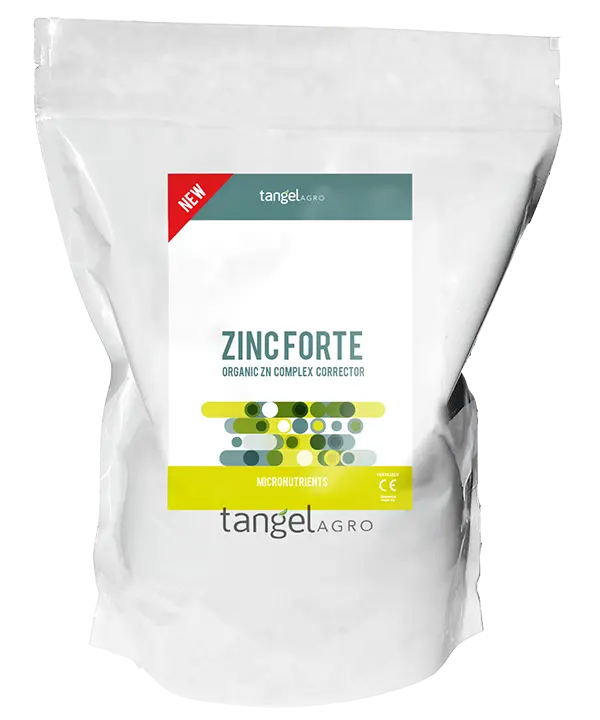
ZINC FORTE is an organic zinc complex containing 30% zinc. It is intended for crops with high zinc requirements, including corn, potatoes, cereals, fruit trees, strawberries, onions, spinach and soybeans.
Zinc is required for protein metabolism and forms part of enzyme systems involved in plant growth. The product is especially relevant where zinc availability is restricted by factors such as high soil pH, high phosphorus levels or poor oxygen conditions in the root zone.
Key product information at a glance.
| Composition | % w/w |
|---|---|
| Zinc (Zn) | 30.00 |
ZINC FORTE provides 30% zinc in the form of an organic complex. The formulation is designed for crops with elevated zinc demand and for growing conditions in which zinc availability may be restricted.
The source specifically recommends preventive applications and advises applying the product as soon as possible when a zinc deficiency becomes evident. Its crop table provides separate fertigation and foliar rates for a wide range of fruit, vegetable and field crops.
Application Guidance: Use the crop-specific fertigation and foliar rates below. Preventive applications are recommended. If zinc deficiency becomes evident, apply as soon as possible. Keep the prepared solution under agitation for 10-15 minutes. The source also gives a general rate of 2-2.5 kg/ha for all crop types without specifying the application route.
| Crops | Timing | Dose | Notes |
|---|---|---|---|
| Apple | Preventively or as soon as zinc deficiency becomes evident | 100-150 g/100 L | Crop-specific foliar rate from the source table. |
| Cereals | Preventively or as soon as zinc deficiency becomes evident | 80-120 g/100 L | Crop-specific foliar rate from the source table. |
| Citrus | Preventively or as soon as zinc deficiency becomes evident | 100-150 g/100 L | Crop-specific foliar rate from the source table. |
| Corn | Preventively or as soon as zinc deficiency becomes evident | 80-120 g/100 L | Crop-specific foliar rate from the source table. |
| Cucumber | Preventively or as soon as zinc deficiency becomes evident | 100-120 g/100 L | Crop-specific foliar rate from the source table. |
| Lettuce | Preventively or as soon as zinc deficiency becomes evident | 100-120 g/100 L | Crop-specific foliar rate from the source table. |
| Melon | Preventively or as soon as zinc deficiency becomes evident | 100-120 g/100 L | Crop-specific foliar rate from the source table. |
| Olive tree | Preventively or as soon as zinc deficiency becomes evident | 100-120 g/100 L | Crop-specific foliar rate from the source table. |
| Pear | Preventively or as soon as zinc deficiency becomes evident | 100-150 g/100 L | Crop-specific foliar rate from the source table. |
| Pepper | Preventively or as soon as zinc deficiency becomes evident | 100-120 g/100 L | Crop-specific foliar rate from the source table. |
| Potato | Preventively or as soon as zinc deficiency becomes evident | 80-120 g/100 L | Crop-specific foliar rate from the source table. |
| Tomato | Preventively or as soon as zinc deficiency becomes evident | 100-120 g/100 L | Crop-specific foliar rate from the source table. |
| Vine | Preventively or as soon as zinc deficiency becomes evident | 100-120 g/100 L | Crop-specific foliar rate from the source table. |
| Crops | Timing | Dose | Notes |
|---|---|---|---|
| Apple | Preventively or as soon as zinc deficiency becomes evident | 400-800 g/1000 m² | Crop-specific fertigation rate from the source table. |
| Cereals | Preventively or as soon as zinc deficiency becomes evident | 200-300 g/1000 m² | Crop-specific fertigation rate from the source table. |
| Citrus | Preventively or as soon as zinc deficiency becomes evident | 400-800 g/1000 m² | Crop-specific fertigation rate from the source table. |
| Corn | Preventively or as soon as zinc deficiency becomes evident | 200-300 g/1000 m² | Crop-specific fertigation rate from the source table. |
| Cucumber | Preventively or as soon as zinc deficiency becomes evident | 300-1500 g/1000 m² | Crop-specific fertigation rate from the source table. |
| Lettuce | Preventively or as soon as zinc deficiency becomes evident | 300-1500 g/1000 m² | Crop-specific fertigation rate from the source table. |
| Melon | Preventively or as soon as zinc deficiency becomes evident | 300-1500 g/1000 m² | Crop-specific fertigation rate from the source table. |
| Olive tree | Preventively or as soon as zinc deficiency becomes evident | 300-400 g/1000 m² | Crop-specific fertigation rate from the source table. |
| Pear | Preventively or as soon as zinc deficiency becomes evident | 400-800 g/1000 m² | Crop-specific fertigation rate from the source table. |
| Pepper | Preventively or as soon as zinc deficiency becomes evident | 300-1500 g/1000 m² | Crop-specific fertigation rate from the source table. |
| Potato | Preventively or as soon as zinc deficiency becomes evident | 200-300 g/1000 m² | Crop-specific fertigation rate from the source table. |
| Tomato | Preventively or as soon as zinc deficiency becomes evident | 300-1500 g/1000 m² | Crop-specific fertigation rate from the source table. |
| Vine | Preventively or as soon as zinc deficiency becomes evident | 300-400 g/1000 m² | Crop-specific fertigation rate from the source table. |
| Crops | Timing | Dose | Notes |
|---|---|---|---|
| All crop types | Preventively or as soon as zinc deficiency becomes evident | 2-2.5 kg/ha | General recommendation stated in the source. The application route is not specified for this general rate. |
ZINC FORTE is intended to prevent and correct zinc deficiency. The source identifies several conditions that can contribute to poor zinc nutrition: low total zinc in the soil, high soil pH, high phosphate applications, high salt concentrations, waterlogging or flooding, high soil organic matter, zinc-inefficient crop varieties and low manure applications.
Keep the prepared solution in the tank under agitation for 10-15 minutes. Shake before use. No specific storage conditions are stated in the source document.
ZINC FORTE is an organic zinc complex corrector containing 30% zinc.
It contains 30% zinc (Zn) on a % w/w basis.
The stated pH of a 1% solution is 6.5 ± 0.5.
It is used to prevent and correct zinc deficiency and to support root development, shoot growth, flower formation, fruit set and uniform maturity.
The source highlights corn, potatoes, cereals, fruit trees, strawberries, onions, spinach and soybeans.
High soil pH, high phosphorus, waterlogging, high salinity, low soil zinc and several other soil or crop factors are listed as causes of zinc deficiency.
Yes. The source provides separate fertigation and foliar rates for 13 crop groups.
The source gives a general recommendation of 2-2.5 kg/ha, without specifying the application route for that general rate.
Fertigation: 400-800 g/1000 m². Foliar spray: 100-150 g/100 L.
Fertigation: 200-300 g/1000 m². Foliar spray: 80-120 g/100 L.
Fertigation: 300-1500 g/1000 m². Foliar spray: 100-120 g/100 L.
Fertigation: 300-400 g/1000 m². Foliar spray: 100-120 g/100 L.
Keep the solution in the tank under agitation for 10-15 minutes.
The source lists 0.5 L, 1 L, 5 L and 1000 L formats.
Highly soluble zinc deficiency corrector complexed with lignosulfonic acid for rapid uptake, protein synthesis, crop …
Highly soluble dual zinc and manganese corrector complexed with lignosulfonic acid for rapid uptake and prevention of…

Highly concentrated Mn-Zn corrector for citrus with rapid uptake, designed to correct zinc and manganese deficiencies…

Rooting biostimulant with IBA, amino acids, fulvic acids and organic matter for early establishment, stronger roots a…
Interested in this product? Contact our team for technical information, availability, application guidance, quotations or distribution opportunities.
Use this form for: