Product Type
Broad-spectrum biofungicide

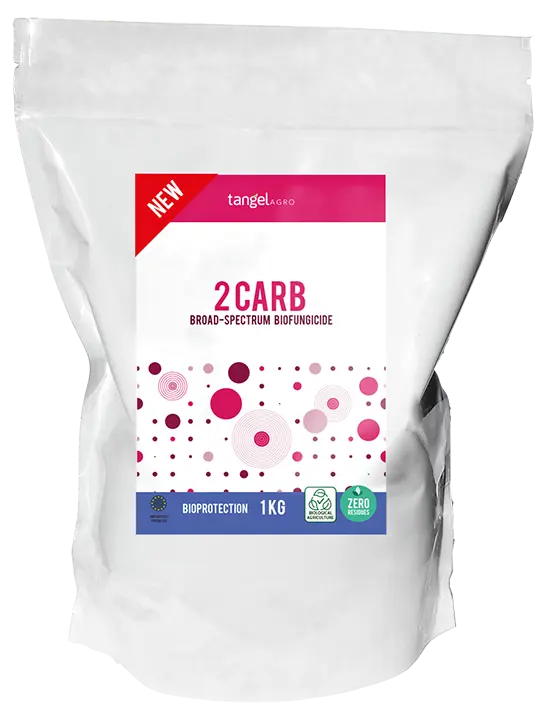
2 CARB is a contact biofungicide based on potassium hydrogen carbonate, described in the datasheet as having preventive and curative action against powdery mildew, botrytis and penicillium.
Its mode of action is linked to changes in pH, osmotic pressure and the bicarbonate/carbonate ion balance in susceptible fungi, acting on contact and inhibiting mycelial hyphae and spores.
Key product information at a glance.
| Composition | % w/w |
|---|---|
| Potassium hydrogen carbonate | 99.0 |
The datasheet describes two modes of action against ectoparasitic fungi: direct desiccant action on spores, hyphae and mycelia, and a preventive surface effect associated with a slight increase in pH that hinders fungal establishment.
It is also presented as a basic substance and as usable in organic farming under the regulations cited in the datasheet.
Application Guidance: General foliar rate: 350-1,000 g/hl with 300-600 L/ha spray volume; apple trees 500-1,000 L/ha. Follow the crop-specific rates and observations in the datasheet.
| Crops | Timing | Dose | Notes |
|---|---|---|---|
| Vegetables in general, berries and general ornamentals | From the second true leaf unfolded (BBCH 12) until full fruit ripening (BBCH 89); 1-8 applications every 10 days. | 350-1,000 g/hl | Objective: powdery mildew caused by Oidium spp., Sphaerotheca fuliginea, Erysiphe cichoracearum and Podosphaera xanthii. |
| Wine grape | From the second true leaf unfolded (BBCH 12) until berries are ready to harvest (BBCH 89). | 450-2,000 g/hl | Objective: powdery mildew (Erysiphe necator). |
| Apple tree | From emerging leaf tips (BBCH 10) until change in fruit color (BBCH 85). | 500-1,000 g/hl | Objective: apple scab (Venturia inaequalis). |
| Crops | Timing | Dose | Notes |
|---|---|---|---|
| Post-harvest oranges, cherries, apples, papayas and other fruits | Post-harvest on harvested fruit; 1-2 applications every 10 days. | 1,000-4,000 g/hl | Immersion or surface treatment. Objective: blue mold (Penicillium italicum) and green mold (Penicillium digitatum). |
Powdery mildew, botrytis, penicillium, apple scab, blue mold and green mold, plus the additional authorized woody-crop uses referenced in the datasheet.
The datasheet states that 2 CARB can be alternated or mixed with fungicidal products under strong disease pressure. Avoid mixing with oil-based formulations and calcium-based products.
Concentrations higher than 1%-2% may cause phytotoxic symptoms. Crop sensitivity varies; verify phytotoxic effects before use.
What is 2 CARB used for?
2 CARB is a contact biofungicide with preventive and curative action documented for diseases including powdery mildew, botrytis and penicillium.
What is the active ingredient in 2 CARB?
The datasheet lists potassium hydrogen carbonate at 990 g/kg.
Can 2 CARB be tank-mixed?
The datasheet allows alternation or mixing with fungicidal products under strong disease pressure but advises avoiding oil-based and calcium-based products.
What foliar rate does the datasheet give?
The general foliar rate is 350-1,000 g/hl, with crop-specific rates shown in the application table.
Natural organic plant defense activator with complexed Zn, Mn and Cu, designed to support systemic defense responses,…

Systemic organic copper fertilizer with gluconic acid, designed for copper correction and to support the crop's natur…
Broad-spectrum inorganic copper fungicide-bactericide and Cu deficiency corrector with multisite contact activity and…

Phosphite fertilizer with manganese and zinc for Mn-Zn deficiency correction, balanced phosphorus nutrition and suppo…
Interested in this product? Contact our team for technical information, availability, application guidance, quotations or distribution opportunities.
Use this form for: