Product Type
Crystalline potassium phosphonate fertilizer

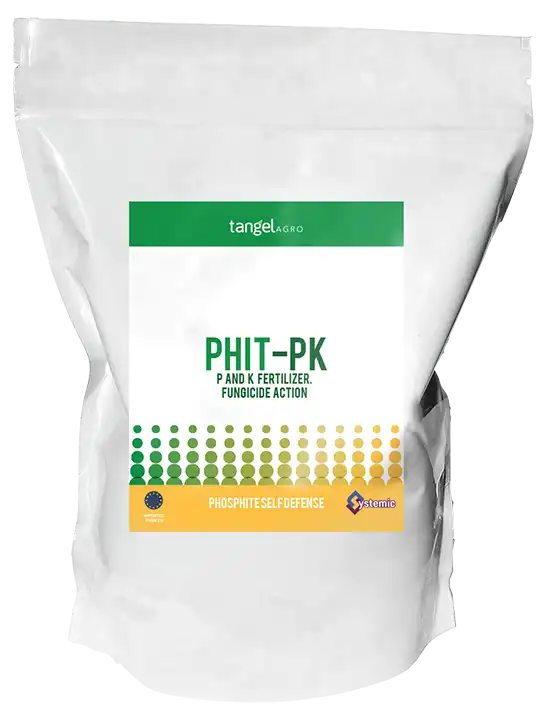
PHIT PK is a water-soluble crystalline potassium phosphonate fertilizer containing 58% phosphorus (P₂O₅) and 38% potassium (K₂O). It is designed for foliar, soil drench, drip irrigation, trunk-painting and hydroponic use.
The formulation is rapidly absorbed through leaves, roots and tree bark and has systemic upward and downward movement. It combines phosphorus and potassium nutrition with stimulation of natural plant defense responses, while supporting biomass, foliar area, soluble sugars, fruit firmness, fruit size, yield and crop quality.
Key product information at a glance.
| Composition | % w/w |
|---|---|
| Potassium Phosphonate | 96.00 |
| Phosphorus (P₂O₅) | 58.00 |
| Potassium (K₂O) | 38.00 |
PHIT PK is a stabilized, completely water-soluble potassium phosphonate powder. It dissolves quickly and homogeneously and is readily taken up through leaves, roots and tree bark.
The source describes systemic upward and downward movement and links the formulation with increased phytoalexin and chitinase content, cell-wall strengthening and activation of natural defense responses. It also provides a concentrated P-K nutritional contribution.
Application Guidance: Follow the crop-specific programmes below. PHIT PK is documented for foliar sprays, soil drenching, drip irrigation, trunk painting and hydroponic use. No hydroponic dose is stated in the supplied document, so no hydroponic rate is inferred.
| Crops | Timing | Dose | Notes |
|---|---|---|---|
| Citrus, avocado and top fruits | Spring and autumn | 5-7 kg/ha | Apply through drip irrigation. Make 2 preventive treatments: one in spring and one in autumn. |
| Strawberries | From rooting to flowering | 2.5-5 kg/ha | Apply through drip irrigation. Make 2-3 treatments from rooting to flowering. |
| Conifer hedges | From spring to mid-summer | 10 g/m of hedge | Apply by drip irrigation or soil drench. Make 4 monthly treatments. For isolated large trees, the source states up to 20-30 g by soil drenching. |
| Peppers | From one week after transplanting until harvesting | 2.5 kg/ha | Apply by drip irrigation or soil drench every 15-21 days. |
| Crops | Timing | Dose | Notes |
|---|---|---|---|
| Citrus, avocado and top fruits | Beginning of spring, summer and beginning of autumn; for top fruits also pre-blossom and/or petal fall | 250 g/hL | High-volume foliar spray. Spray volume: 1000-3000 L/ha. Three preventive treatments per season are recommended. In top fruits, treat once or twice pre-blossom and/or at petal fall. |
| Citrus, avocado and top fruits | Beginning of spring, summer and beginning of autumn; for top fruits also pre-blossom and/or petal fall | 600 g/hL | Mistblower application. Spray volume: 300-1200 L/ha. Three preventive treatments per season are recommended. |
| Strawberries | From the start of flowering to the end of harvesting | 250 g/hL | Spray volume: 800-1000 L/ha. Make 3-4 treatments. |
| Vineyards | From flowering to ripening | 500 g/hL | Mistblower application. Spray volume: 600-1000 L/ha. Treat every 15 days. The source recommends tank mixing with preventive fungicides such as Folpet or Mancozed. |
| Table grapes | From flowering to ripening | 250 g/hL | Spray volume: 300-500 L/ha. Treat every 15 days. The source recommends tank mixing with preventive fungicides such as Folpet or Mancozed. |
| Lettuce and leaf crops | First application 7-10 days after transplanting; second application 15 days later | 250 g/hL | Spray volume: 600-1000 L/ha. Two treatments are recommended. |
| Onions | 1st: three true leaves · 2nd: 15 days later · 3rd: 15-21 days later | 1.5-2.5 kg/ha | Spray volume: 300-500 L/ha. Three preventive treatments per season. |
| Conifer hedges | From spring to mid-summer | 250 g/hL | Spray volume: 600-1000 L/ha. Make 4 monthly treatments. |
| Tomatoes and cucurbits | From flowering until mid-to-late harvesting | 150-250 g/hL | Spray volume: 800-1000 L/ha. Apply every 15 days. |
| Turf and golf courses | From the beginning of spring to mid-autumn | 0.75-1 kg/1000 m² | Monthly treatments. The source states foliar or sprinkler-irrigation application. |
| Crops | Timing | Dose | Notes |
|---|---|---|---|
| Citrus, avocado and top fruits — affected trunks or stems | On affected stem areas | 300 g/L | Application method: Trunk painting. Scratch the affected part of the stem and paint the area. In severe cases, make three treatments per season. |
PHIT PK is positioned for phosphorus and potassium nutrition together with systemic support of natural plant defenses. The supplied document also presents it for disease-control programmes and links its use with stronger cell walls, increased biomass and foliar area, higher soluble sugars, fruit firmness, fruit size, yield and quality.
For vineyard and table-grape programmes, the source recommends tank mixing with preventive fungicides such as Folpet or Mancozed. No broader compatibility statement is provided in the supplied technical document.
PHIT PK is a crystalline, water-soluble potassium phosphonate fertilizer with phosphorus and potassium.
It contains 96% potassium phosphonate, 58% phosphorus (P₂O₅) and 38% potassium (K₂O) on a % w/w basis.
It combines P-K nutrition with systemic support of natural plant defense responses and is also positioned in the source for disease-control programmes.
The source states that it stimulates phytoalexin production and is associated with increased phytoalexin and chitinase content and stronger cell walls.
It is described as readily taken up by leaves, roots and tree bark, with systemic upward and downward movement.
Yes. The source provides high-volume foliar, mistblower, trunk-painting and drip-irrigation programmes for these crops.
Yes. Apply 2.5-5 kg/ha through drip irrigation from rooting to flowering, or 250 g/hL foliarly from flowering to the end of harvest.
Apply 500 g/hL by mistblower every 15 days from flowering to ripening. For table grapes, the foliar rate is 250 g/hL.
Yes. Specific programmes are provided for lettuce and leaf crops, onions, tomatoes, cucurbits and peppers.
Yes. Apply 0.75-1 kg per 1000 m² monthly from the beginning of spring to mid-autumn by foliar or sprinkler irrigation.
Hydroponic application is listed among the supported methods, but no hydroponic dose is provided in the supplied document.
PHIT PK is available in 1 kg, 2 kg, 5 kg and 20 kg bags.
Phosphite fertilizer with manganese and zinc for Mn-Zn deficiency correction, balanced phosphorus nutrition and suppo…
Natural organic plant defense activator with complexed Zn, Mn and Cu, designed to support systemic defense responses,…
Broad-spectrum inorganic copper fungicide-bactericide and Cu deficiency corrector with multisite contact activity and…
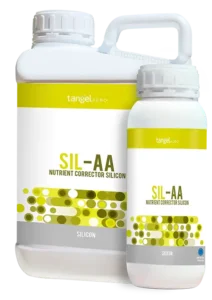
Silicon and potassium nutrient corrector with plant amino acids for rapid uptake, abiotic-stress support, root develo…
Interested in this product? Contact our team for technical information, availability, application guidance, quotations or distribution opportunities.
Use this form for: