Tangel Agro

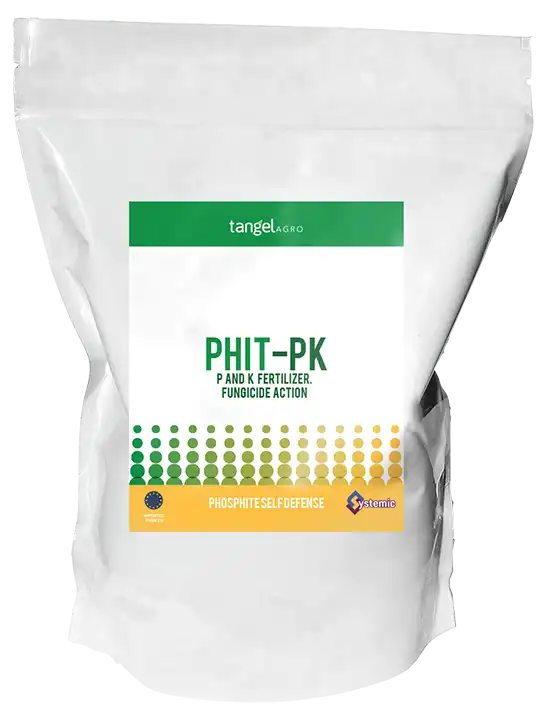
PHIT PK

PHIT PK

Highly Concentrated Potassium Phosphonate for Systemic Crop Defence and P–K Nutrition

PHIT PK is a stabilised crystalline powder containing 96% potassium phosphonate, equivalent to 58% phosphorus pentoxide (P₂O₅) and 38% potassium oxide (K₂O). The formulation dissolves rapidly and homogeneously in water, making it suitable for foliar spraying, fertigation, soil drenching, sprinkler irrigation, hydroponic systems and trunk painting.

Once applied, PHIT PK can be absorbed through leaves, roots and the bark of woody crops. Its systemic movement distributes the active nutrients throughout the plant, including newly developing and sensitive tissues. The product stimulates the production of phytoalexins and supports chitinase activity, helping activate the crop’s natural defence response, strengthen cell walls and improve resistance to attacks associated with oomycete pathogens. It also contributes to higher phosphorus content, increased biomass and foliar area, improved fruit firmness, higher soluble sugar levels, better fruit size and increased yield potential.

Composition and Guaranteed Analysis

Composition

%w/w

Citrus essential oils (Limonene)

7,00

Inert ingredients

93,00

Composition%w/w
Potassium Phosphonate96.0
Phosphorus (P₂O₅)58.0
Potassium (K₂O)38.0

Origin and Certifications

PHIT PK is presented as a European-origin agricultural input and is available in professional bag formats for use in commercial crop-production programmes. The product is manufactured as a high-concentration, water-soluble and stabilised potassium phosphonate formulation.

The supplied technical datasheet does not identify specific third-party certifications or organic-production approvals. Certification, registration and authorised claims may differ between countries. Users should consult Tangel Agro and the locally approved product documentation before positioning PHIT PK as a fertiliser, biostimulant, plant defence inducer or plant-protection product in a particular market.

PHIT PK provides an integrated combination of nutritional, physiological and crop-protection benefits:

  • Supplies highly concentrated phosphorus and potassium.
  • Activates the plant’s natural defence mechanisms.
  • Stimulates phytoalexin and chitinase production.
  • Supports systemic protection of roots, leaves, stems and new tissues.
  • Strengthens plant cell walls.
  • Helps crops withstand oomycete-related disease pressure.
  • Supports biomass production and leaf-area development.
  • Contributes to higher soluble sugar content.
  • Improves fruit firmness and post-harvest quality potential.
  • Supports fruit sizing and overall crop yield.
  • Offers multiple foliar, soil and trunk-application possibilities.

Systemic Activity

PHIT PK is readily absorbed through foliage, roots and bark. Its upward and downward systemic movement helps distribute the formulation to active growing points and other sensitive plant tissues.

Natural Defence Activation

The formulation stimulates the production of phytoalexins and supports chitinase activity, reinforcing the crop’s own defence response against pathogen pressure.

Concentrated P–K Nutrition

With 58% P₂O₅ and 38% K₂O, PHIT PK supplies two essential macronutrients involved in energy transfer, root activity, water regulation, fruit development and quality.

Stronger Plant Structures

By supporting cell-wall strengthening, PHIT PK contributes to firmer tissues, improved plant integrity and greater resilience under challenging growing conditions.

Yield and Quality Support

Regular preventive applications can support biomass, foliar development, soluble sugar accumulation, fruit firmness, fruit size and final yield.

Flexible Application

The product can be used by foliar spray, fertigation, drenching, sprinkler irrigation, hydroponic application and trunk painting, depending on crop requirements.

  • Very high concentration: 96% w/w potassium phosphonate.
  • Crystalline formulation: concentrated powder with efficient storage and handling.
  • Fully water-soluble: dissolves rapidly and evenly in the spray or fertigation tank.
  • Stabilised product: designed to maintain homogeneous application.
  • Bidirectional systemic movement: translocation towards both upper and lower plant tissues.
  • Multiple absorption pathways: uptake through leaves, roots and tree bark.
  • Preventive positioning: suitable for planned programmes before severe disease development.
  • Broad crop versatility: applicable to fruit trees, vegetables, berries, vines, ornamentals and turf.
  • Multiple application systems: compatible with common foliar and irrigation-based methods.
  • Combined physiological action: supports crop nutrition, defence activation and quality development.

Dosage & applications

CROPSASSOCIATESMAXIMUM Nº OF TREATMENTSLAST MOMENT OF APPLICATIONSPRAYING EQUIPMENT
Citrus, avocado and top fruit250 g/hL by high-volume spray; 600 g/hL by mistblower; 5–7 kg/ha by fertigation; 300 g/L for trunk painting3 preventive treatments per season. For top fruit, 1–2 applications at pre-blossom and/or petal fall. Up to 3 trunk treatments in severe casesAt the beginning of spring, summer and autumnHigh-volume foliar spray, mistblower, drip irrigation or trunk painting
Strawberries2.5–5 kg/ha by drip irrigation or 250 g/hL by foliar spray2–3 fertigation treatments or 3–4 foliar treatmentsFrom root establishment to flowering by fertigation; from flowering until the end of harvest by foliar applicationDrip irrigation or foliar spray
Vineyard and table grapes500 g/hL for vineyards; 250 g/hL for table grapesNot specified; repeat at approximately 15-day intervalsFrom flowering to ripeningMistblower or foliar spray
Lettuce and leafy crops2.5 kg/ha2 treatmentsFirst application 7–10 days after transplanting; second application 15 days laterFoliar spray
Onions1.5–2.5 kg/ha3 treatmentsAt the three-true-leaf stage, 15 days later and again after a further 15–21 daysFoliar spray
Conifer hedges250 g/hL by foliar spray or 10 g per linear metre by soil application4 monthly treatmentsFrom spring to mid-summerFoliar spray, drip irrigation or soil drench
Tomatoes and cucurbits150–250 g/hLNot specified; repeat every 15 daysFrom flowering until the middle or end of harvestFoliar spray
Peppers2.5 kg/haNot specified; repeat every 15–21 daysFrom one week after transplanting until harvestDrip irrigation or soil drench
Turf and golf courses0.75–1 kg/1,000 m²Monthly applicationsFrom the beginning of spring until mid-autumnFoliar spray or sprinkler irrigation

CROPS

ASSOCIATES

MAXIMUM Nº OF TREATMENTS

LAST MOMENT OF APPLICATION

SPRAYING EQUIPMENT

All crops

All approved agrochemicals

Follow the conditions established for the use of the associated agrochemical.

Follow the conditions established for the use of the associated agrochemical.

Suitable for use in various application techniques: Full coverage application, low volume concentrate, spray, pivot, and spray.

Vegetative nutrition

Authorized uses, rate and times of application

CROPSPRODUCT TYPESADJUVANT FUNCTIONWETTA FINAL CONCENTRATION
Water-soluble potassium phosphonate P–K fertilizerP and K nutrition, natural defence activation and support against oomycete-related disease pressure250–600 g/hL foliar; 5–7 kg/ha by fertigation; 300 g/L for trunk painting
Water-soluble potassium phosphonate P–K fertilizerRoot-zone support, natural defence activation and crop-quality improvement250 g/hL foliar or 2.5–5 kg/ha by fertigation
Water-soluble potassium phosphonate P–K fertilizerSystemic defence support, tissue strengthening and fruit-quality improvement500 g/hL for vineyards or 250 g/hL for table grapes
Water-soluble potassium phosphonate P–K fertilizerPreventive defence activation and support for early crop establishment2.5 kg/ha
Water-soluble potassium phosphonate P–K fertilizerPreventive defence support during vegetative development1.5–2.5 kg/ha
Water-soluble potassium phosphonate P–K fertilizerSystemic defence activation and support for root and foliar health250 g/hL foliar or 10 g per linear metre by soil application
Water-soluble potassium phosphonate P–K fertilizerNatural defence activation, P–K nutrition and yield-quality support150–250 g/hL
Water-soluble potassium phosphonate P–K fertilizerRoot-zone defence support and nutritional reinforcement2.5 kg/ha
Water-soluble potassium phosphonate P–K fertilizerSupport for turf vigour, tissue strength and natural defence mechanisms0.75–1 kg/1,000 m²

GENERAL DOSE: For foliar applications, use 150–600 g/hL or 1.5–2.5 kg/ha, depending on the crop, canopy volume and application equipment. For fertigation or soil drenching, apply 2.5–7 kg/ha. On turf and golf courses, use 0.75–1 kg per 1,000 m². For conifer hedges, apply 10 g per linear metre, increasing to 20–30 g per tree for large isolated specimens. For trunk painting, prepare a solution at 300 g/L. Apply preferably as a preventive treatment and adjust the frequency according to crop stage, disease pressure and local label requirements.

CROPS

PRODUCT TYPES

ADJUVANT FUNCTION

WETTA FINAL CONCENTRATION

All crops

Insecticides, Fungicides, Acaricides, Herbicides, Protection, Plant Growth Regulators, Foliar Fertilizers, Biostimulants

Dispersion and wetting

0,05-0,15% V/V

Dispersion, Wetting + Anti-rebound, Rewetting, deposition

>0,15->0,25% V/V

Dispersion, wetting + anti-rebound, rewetting, deposition + penetration

0,25 – 0,30% V/V

Features and Properties

PHIT PK is a highly concentrated phosphorus and potassium fertiliser formulated as a stabilised, fully water-soluble crystalline powder. It contains 96.0% w/w potassium phosphonate, providing 58.0% w/w phosphorus expressed as P₂O₅ and 38.0% w/w potassium expressed as K₂O. The product dissolves rapidly and homogeneously in water, which facilitates accurate preparation and uniform distribution through different application systems.

Its systemic behaviour allows upward and downward movement within the plant after uptake through leaves, roots or bark. PHIT PK supports phosphorus and potassium nutrition while stimulating phytoalexin production, chitinase activity and cell-wall strengthening. It can be applied by foliar spray, fertigation, soil drenching, sprinkler irrigation, hydroponic systems or trunk painting, and is available in 1 kg, 2 kg, 5 kg and 20 kg bags.
Recommended Crops and Timing of Application

Fruit Trees

In citrus, avocado and top fruit, position PHIT PK at the beginning of the main seasonal risk periods. Spring, summer and early-autumn treatments help maintain active nutrient supply and defence readiness. In deciduous fruit crops, pre-blossom and petal-fall applications may be incorporated into preventive programmes where locally authorised.

Grapevines and Table Grapes

Begin applications around flowering and repeat during fruit development until ripening. Regular treatment at approximately 15-day intervals supports canopy resilience, bunch development and fruit-quality parameters.

Strawberries

Apply through fertigation during root establishment and before flowering to support root-zone protection. Foliar treatments may then be used from flowering through the harvest period.

Lettuce and Leafy Vegetables

Use shortly after transplanting, when root systems and young leaves are especially vulnerable. A second application approximately two weeks later helps maintain protection during early canopy development.

Onions

Start at the three-true-leaf stage and repeat during early vegetative growth. Preventive positioning is preferable to waiting until visible disease symptoms have become established.

Tomatoes and Cucurbits

Begin foliar applications at flowering and continue throughout the productive cycle at approximately 15-day intervals. Ensure uniform coverage of both upper and lower foliage.

Peppers

Apply through the irrigation system beginning approximately one week after transplanting. Repeat every 15–21 days to support roots and vegetative growth throughout the crop cycle.

Conifers and Ornamental Hedges

Apply during spring and early summer, when vegetative activity and disease risk are increasing. Soil drenching can complement foliar treatments, particularly for large trees or plants with limited foliar access.

Turf and Golf Courses

Use monthly from early spring to mid-autumn. Apply through foliar spraying or sprinkler irrigation and ensure uniform distribution over the treated surface.

FAQ

What is PHIT PK?

PHIT PK is a highly concentrated, water-soluble potassium phosphonate formulation that supplies phosphorus and potassium while supporting the crop’s systemic natural defence response.

What is the composition of PHIT PK?

It contains 96% w/w potassium phosphonate, providing 58% w/w phosphorus expressed as P₂O₅ and 38% w/w potassium expressed as K₂O.

How does PHIT PK work inside the plant?

The formulation is absorbed through leaves, roots and bark. It moves systemically in both upward and downward directions, helping reach active growing tissues throughout the plant.

Does PHIT PK activate plant defences?

Yes. It stimulates phytoalexin production and supports chitinase activity, two mechanisms associated with the plant’s natural response to pathogen pressure.

Is PHIT PK a fertiliser or a fungicide?

The datasheet presents PHIT PK as a P–K fertiliser with fungicidal and disease-control action. Its legal classification depends on the claims, registration and regulations applicable in each country. Only locally authorised claims should appear on labels and commercial materials.

Which pathogens is PHIT PK intended to help manage?

It is principally positioned for preventive programmes involving oomycete-related diseases, including Phytophthora pressure. Crop diagnosis and an integrated management programme are recommended.

Can PHIT PK be applied by fertigation?

Yes. It can be applied through drip irrigation, soil drenching and other suitable irrigation systems, provided the product is fully dissolved and distributed evenly through the active root zone.

Can it be used as a foliar spray?

Yes. Foliar rates generally range from 150 to 600 g/hL, depending on the crop, equipment, canopy volume and programme described in the technical recommendations.

Can PHIT PK be applied to tree trunks?

Yes. The datasheet recommends trunk painting at 300 g/L after cleaning or scraping the target bark area. This use must comply with local product registration and application requirements.

Is PHIT PK suitable for preventive use?

Preventive application is the preferred positioning. Treatments should begin before severe symptoms appear and should be timed according to crop stage, weather conditions and expected disease pressure.

Can PHIT PK be mixed with other products?

Compatibility depends on water quality, tank pH and the characteristics of the other formulation. Conduct a jar test before preparing a full tank and use only combinations permitted by the local label. Avoid mixing products without technical guidance.

What precautions should be taken during application?

Use appropriate personal protective equipment, avoid inhaling dust, maintain continuous agitation during preparation and follow all safety instructions on the label and safety data sheet. Do not exceed the locally authorised dose or number of applications.

Become our distributor

Fill out the form to obtain information about the distributors closest to your zip code.