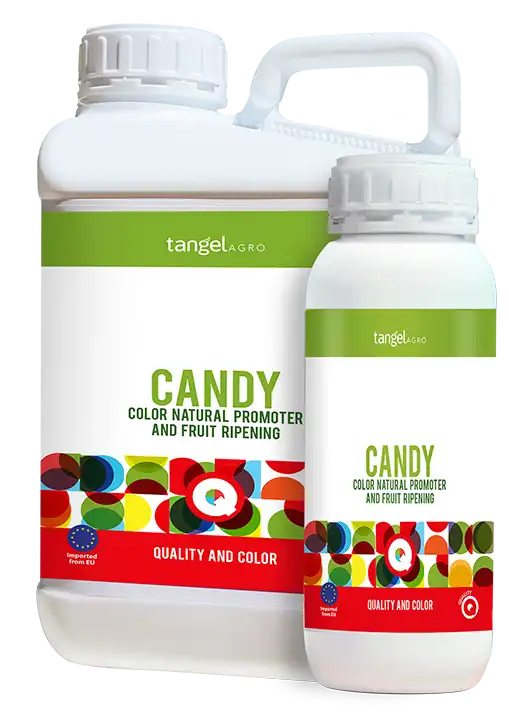
CANDY is specially designed for use during fruit enlargement, colour change and ripening. Its organic matrix, rich in polysaccharides and uronic acids, works together with a carefully balanced supply of macro- and micronutrients to support the physiological processes involved in fruit filling, maturation and quality formation.
The formulation contains a high-molecular-weight organic polymer that helps maintain the elasticity, hydration and structural consistency of the fruit skin. Calcium and magnesium contribute to stronger plant tissues and improved fruit firmness, while potassium supports sugar accumulation, colour development and ripening. Boron and zinc complement the formulation by supporting reproductive development and the metabolic processes associated with fruit growth and maturation.
Through foliar or soil application, CANDY helps produce fruit with more uniform colour, better calibre, greater firmness and improved storage potential. It is suitable for fruit crops, citrus, olives, greenhouse vegetables, open-field horticultural crops and ornamental plants. The composition and application rates below are based on the official product datasheet.
Composition
%w/w
Citrus essential oils (Limonene)
7,00
Inert ingredients
93,00
| Composition | %w/w |
|---|---|
| Total Nitrogen (N) | 3.0 |
| Potassium (K₂O) | 5.0 |
| Calcium (CaO) | 5.0 |
| Magnesium (MgO) | 2.0 |
| Polysaccharides | 25.0 |
| Uronic Acids | 2.0 |
| Boron (B) | 0.1 |
| Zinc (Zn) | 0.1 |
Origin and Certifications
CANDY is a European-origin agricultural input and is presented in the product datasheet as an organic and natural product. Its formulation combines an organic polysaccharide matrix with a balanced selection of macro- and micronutrients.
The available datasheet indicates that the product is imported from the European Union. However, it does not specify an official organic-input certification, registration number or individual certification scheme. Certification and authorization requirements may vary between countries, so the applicable documentation should be confirmed before commercial distribution or use in certified production systems.
CANDY provides a comprehensive approach to fruit-quality management by simultaneously supporting colour, ripening, firmness, calibre and sugar accumulation.
Its main agronomic benefits include:
CANDY promotes more uniform colour formation during the final stages of fruit development. It is especially suitable for crops in which external appearance and homogeneous maturation directly influence commercial value.
The potassium-rich formulation supports the movement and accumulation of carbohydrates in developing fruit, contributing to improved sweetness and overall eating quality.
Calcium, magnesium and the organic polymer matrix help reinforce fruit tissues and maintain skin elasticity. This contributes to firmer fruit with improved resistance during harvesting, handling, transport and storage.
Applications from veraison or the beginning of colour change help synchronize maturation, facilitating harvest planning and improving the uniformity of marketable produce.
The combined supply of potassium, calcium, magnesium and organic polysaccharides supports fruit filling and helps growers achieve more consistent commercial size.
By supporting fruit firmness, skin integrity and tissue consistency, CANDY helps maintain quality after harvest and may reduce losses associated with softening and premature deterioration.
| CROPS | ASSOCIATES | MAXIMUM Nº OF TREATMENTS | LAST MOMENT OF APPLICATION | SPRAYING EQUIPMENT |
|---|---|---|---|---|
| Fruit crops: table grapes, wine grapes, apple, pear, peach, nectarine, apricot, cherry, kiwi and similar crops | 400–450 ml/hl | 2–3 applications | Begin at veraison or the onset of colour change; repeat every 7 days | Foliar spray |
| Citrus, oil olives and table olives | 400–450 ml/hl | 2–3 applications | Begin at the onset of fruit maturation and colour development; repeat every 7 days | Foliar spray |
| Open-field vegetable and industrial crops: tomato, pepper, aubergine, strawberry, watermelon, melon, borlotti bean, sugar beet and similar crops | 400–450 ml/hl | 2–3 applications | Begin at the onset of fruit ripening or colour change; repeat every 7 days | Foliar spray |
| Greenhouse vegetable crops | 300–400 ml/hl | 2 applications per fruiting stage | Apply from the middle of the fruit-enlargement stage | Foliar spray |
| Flowering plants, ornamental crops and cut flowers | 200–300 ml/hl | According to the crop programme | Apply during active growth and flowering | Foliar spray |
| All crops | 0.8–1.0 L/1,000 m² | According to the crop programme | Apply from the middle of the fruit-enlargement stage | Soil application or fertigation |
CROPS
ASSOCIATES
MAXIMUM Nº OF TREATMENTS
LAST MOMENT OF APPLICATION
SPRAYING EQUIPMENT
All crops
All approved agrochemicals
Follow the conditions established for the use of the associated agrochemical.
Suitable for use in various application techniques: Full coverage application, low volume concentrate, spray, pivot, and spray.
Vegetative nutrition
| CROPS | PRODUCT TYPES | ADJUVANT FUNCTION | WETTA FINAL CONCENTRATION |
|---|---|---|---|
| Liquid fruit-quality and ripening enhancer | Promotes natural colour development, sugar accumulation, firmness and uniform ripening | 400–450 ml/hl | |
| Liquid fruit-quality and ripening enhancer | Supports fruit enlargement, colour development, firmness and maturation | 400–450 ml/hl | |
| Liquid fruit-quality and ripening enhancer | Improves fruit quality, firmness, calibre and ripening uniformity | 300–400 ml/hl | |
| Liquid nutritional quality enhancer | Supports plant quality and flowering performance | 200–300 ml/hl | |
| Liquid nutritional and fruit-quality enhancer | Supports fruit enlargement, maturation and final crop quality | 0.8–1.0 L/1,000 m² |
GENERAL DOSE: Apply CANDY by foliar spray at 200–450 ml/hl, depending on the crop and growth stage: use 400–450 ml/hl for fruit crops, citrus, olives and open-field vegetables, 300–400 ml/hl for greenhouse vegetables and 200–300 ml/hl for flowering plants, ornamentals and cut flowers. For soil application, use 0.8–1.0 L per 1,000 m², preferably from the middle of the fruit-enlargement stage; the datasheet also recommends combining it with CHELAPOTASH at 4 kg per 1,000 m².
CROPS
PRODUCT TYPES
ADJUVANT FUNCTION
WETTA FINAL CONCENTRATION
All crops
Insecticides, Fungicides, Acaricides, Herbicides, Protection, Plant Growth Regulators, Foliar Fertilizers, Biostimulants
Dispersion and wetting
0,05-0,15% V/V
Dispersion, Wetting + Anti-rebound, Rewetting, deposition
>0,15->0,25% V/V
Dispersion, wetting + anti-rebound, rewetting, deposition + penetration
0,25 – 0,30% V/V
CANDY is a liquid fruit-quality enhancer designed for both foliar and soil application. Its formulation combines an organic matrix rich in polysaccharides with a balanced supply of nitrogen, potassium, calcium, magnesium, boron and zinc. This combination supports fruit development during enlargement, colour change and ripening, helping crops achieve more uniform maturation and improved commercial quality.
The product contains 25% polysaccharides and 2% uronic acids, together with a high-molecular-weight organic polymer that contributes to fruit-skin elasticity, hydration and structural consistency. Calcium and magnesium help reinforce plant tissues and improve firmness, while potassium supports sugar accumulation, colour development and the final ripening process.
CANDY is particularly suitable for improving fruit colour, calibre, firmness and post-harvest performance. It can be integrated into quality programmes for fruit crops, citrus, olives, vegetables, industrial crops and ornamentals, with application timing adapted to each crop and production objective.
Apply at the beginning of veraison and repeat two or three times at seven-day intervals. CANDY is suitable for table and wine grapes where uniform colour, sugar content, berry firmness and synchronized maturation are important.
Begin applications as the fruit enters the final enlargement and maturation stages. Repeat according to fruit development and the expected harvest date to support firmness, colour and storage quality.
Apply from the beginning of colour change. A programme of closely spaced applications can help improve external appearance, firmness and uniform ripening.
Use during the later fruit-enlargement period and before harvest to support calibre, sugar accumulation and tissue consistency.
Apply when the fruit begins its natural colour transition and maturation process. Repeat at seven-day intervals where necessary to improve uniformity and external quality.
Begin during the initial maturation stage. Applications may support more uniform development and improve the quality characteristics of the harvested fruit.
Use from the middle of fruit enlargement and continue into the colour-change stage. CANDY is suitable for both greenhouse and open-field production.
Apply during active fruit enlargement and at the beginning of ripening to support colour, firmness, sugar content and post-harvest quality.
Begin during fruit enlargement and repeat as the fruit approaches physiological maturity. Applications are intended to support sugar accumulation, consistency and uniform ripening.
Apply during active growth and flowering at the lower recommended foliar rate. Adapt the programme to the crop cycle, market requirements and local growing conditions.
CANDY is used to improve fruit colour, maturation, firmness, calibre, sugar content and post-harvest quality. It is primarily applied during fruit enlargement, colour change and ripening.
No artificial colouring agent is identified in the datasheet. CANDY is formulated to support the crop’s natural colour-development and ripening processes through its organic matrix and balanced nutritional composition.
The best application period is generally from the middle of fruit enlargement through veraison, colour change and ripening. The exact timing depends on the crop and production objective.
For most fruit crops, citrus, olives and open-field vegetables, two or three applications at seven-day intervals are recommended. Greenhouse vegetables generally receive two treatments during each fruiting stage.
CANDY is suitable for soil application and can be incorporated into an appropriate irrigation or fertigation programme. The general soil rate is 0.8–1.0 L per 1,000 m².
The product is formulated to support sugar accumulation during ripening. Its potassium content and organic matrix contribute to the processes associated with carbohydrate movement and final fruit quality.
CANDY supports fruit firmness, skin elasticity and tissue consistency. These effects can help maintain fruit quality during harvesting, handling, transport and storage.
Yes. For greenhouse vegetable crops, the recommended foliar dose is 300–400 ml/hl, with two treatments during each fruiting stage beginning from the middle of fruit enlargement.
The datasheet specifically recommends combining the soil application with CHELAPOTASH at 4 kg per 1,000 m². For other mixtures, conduct a small compatibility test before preparing the complete tank and follow local technical guidance.
The datasheet describes CANDY as an organic and natural product, but it does not identify a specific organic-farming certification or certification number. Suitability for certified organic production should therefore be verified according to the regulations of the destination market.
Fill out the form to obtain information about the distributors closest to your zip code.