Tangel Agro

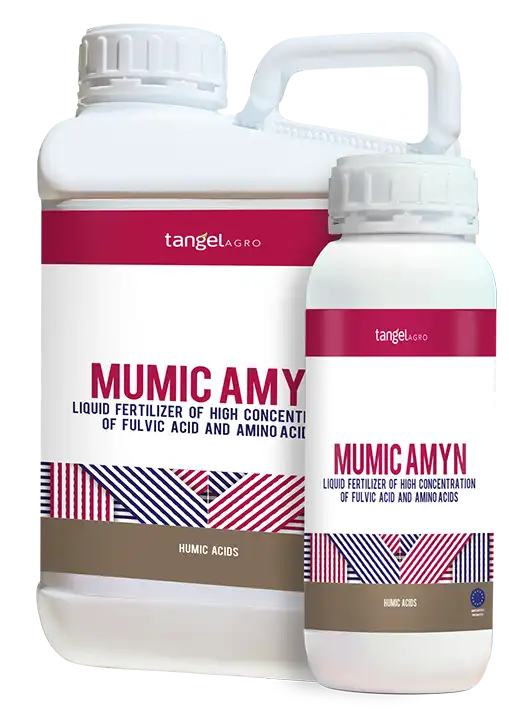
MUMIC AMYN

MUMIC AMYN

Concentrated Humic and Amino Acid Biostimulant for Vigorous Crop Growth

MUMIC AMYN is a highly bioactive growth-promoting and soil-improving solution suitable for agricultural, horticultural and ornamental crops. Its concentrated formulation combines a total humic extract with free amino acids and polysaccharides, providing complementary benefits in both the rhizosphere and the aerial parts of the plant.

When applied through fertigation, MUMIC AMYN improves the conditions surrounding the root system and supports the biological processes involved in nutrient availability. Its humic components help optimize nutrient use, while its amino acids provide readily available organic compounds that support crop metabolism, especially during periods of rapid development or physiological stress.

Foliar applications provide fast crop support during key growth stages. The product can be incorporated into regular nutrition programmes to promote vegetative development, flowering, fruit set and fruit sizing. Its versatility makes it suitable for use throughout the crop cycle, either alone or as part of integrated fertilization strategies.

Composition and Guaranteed Analysis

Composition

%w/w

Citrus essential oils (Limonene)

7,00

Inert ingredients

93,00

Composition%w/w
Total humic extract14.0
Humic acids14.0
Free amino acids14.0
Polysaccharides8.0

Origin and Certifications

MUMIC AMYN is produced through a bacterial fermentation process using plant-derived raw materials. This process generates a complex plant-based biostimulant matrix containing humic substances, amino acids, polysaccharides and naturally occurring organic compounds.

The formulation is natural in origin, completely water-soluble and suitable for foliar application and fertigation. Certification status and regulatory classification may vary depending on the destination market. Users should consult the product label, local registration documentation and Tangel Agro’s technical department before commercial application.

MUMIC AMYN provides simultaneous support for crop growth, root activity, nutrient efficiency and soil biological performance. Its combination of humic substances and amino acids helps plants establish more effectively, maintain active metabolism and respond more efficiently to challenging growing conditions.

The product acts in both the soil–root environment and the aerial parts of the plant. In the soil, it supports nutrient availability and microbial activity. Within the crop, it contributes to nutrient transport, vegetative vigour, stress recovery and the physiological processes involved in yield and quality development.

  • Promotes stronger and more extensive root development.
  • Improves nutrient absorption, transport and utilization.
  • Supports vigorous and balanced crop growth.
  • Helps increase tolerance to environmental and physiological stress.
  • Encourages beneficial microbial activity in the soil.
  • Supports crop recovery after adverse growing conditions.
  • Contributes to improved yield potential and harvest quality.
  • Suitable for both foliar application and fertigation.
  • Can be used throughout the crop cycle.
  • Provides a fully water-soluble formulation for easy application.

High Bioavailability

The soluble organic components in MUMIC AMYN are readily available to the crop, supporting a rapid physiological response following foliar or root-zone application.

High Solubility

Its completely water-soluble liquid formulation facilitates uniform dilution and distribution through conventional foliar spraying and drip-irrigation systems.

Concentrated Organic Matrix

MUMIC AMYN combines a concentrated humic extract with free amino acids and polysaccharides, providing complementary action on root growth, nutrient dynamics and crop metabolism.

Fermentation-Derived Formulation

The bacterial fermentation process generates a diverse range of plant-derived compounds, including peptides, betaines, antioxidants, vitamins, carbohydrates and secondary metabolites.

Application Flexibility

The product can be applied to the foliage or through irrigation systems, allowing it to be integrated into different crop programmes, production systems and phenological stages.

Stable Liquid Formulation

Its liquid format simplifies measuring, dilution and incorporation into professional fertilization programmes.

Dosage & applications

CROPSASSOCIATESMAXIMUM Nº OF TREATMENTSLAST MOMENT OF APPLICATIONSPRAYING EQUIPMENT
Greenhouse vegetablesFoliar: 200–300 ml/100 L water; Fertigation: 5–10 L/haApply every 7–14 daysThroughout the crop cycleFoliar spraying or drip fertigation
Leafy vegetablesFoliar: 200–300 ml/100 L water; Fertigation: 5–10 L/haAs requiredMainly during the early growth stagesFoliar spraying or drip fertigation
Fruiting vegetables and cut flowersFoliar: 200–300 ml/100 L water; Fertigation: 5–10 L/ha4–6 applicationsFrom crop establishment onwards, according to development and stressFoliar spraying or drip fertigation
Blueberries and cranberries10 L/ha per application3 applicationsBudding, fruit set and fruit sizingFertigation or soil application
Orchards, citrus, subtropical crops and olivesFoliar: 200–300 ml/100 L water; Fertigation: 5–10 L/ha3 key applications; additional applications when requiredBud break, pre-bloom and after fruit setFoliar spraying or drip fertigation
GrapevinesFoliar: 200–300 ml/100 L water; Fertigation: 5–10 L/ha2–3 applicationsFrom post-fruit set until the beginning of ripeningFoliar spraying or drip fertigation
CerealsMinimum 4 L/ha1 application minimumDuring active vegetative growth; in summer cereals, 35–40 days after sowingFoliar spraying

CROPS

ASSOCIATES

MAXIMUM Nº OF TREATMENTS

LAST MOMENT OF APPLICATION

SPRAYING EQUIPMENT

All crops

All approved agrochemicals

Follow the conditions established for the use of the associated agrochemical.

Follow the conditions established for the use of the associated agrochemical.

Suitable for use in various application techniques: Full coverage application, low volume concentrate, spray, pivot, and spray.

Vegetative nutrition

Authorized uses, rate and times of application

CROPSPRODUCT TYPESADJUVANT FUNCTIONWETTA FINAL CONCENTRATION
Liquid biostimulant / humic and amino acid fertilizerPromotes crop vigour, root growth, nutrient uptake and stress toleranceFoliar: 200–300 ml/100 L water; Fertigation: 5–10 L/ha
Liquid biostimulant / humic and amino acid fertilizerSupports flowering, fruit set, fruit development and crop recovery10 L/ha per application
Liquid biostimulant / humic and amino acid fertilizerImproves nutrient transport, vegetative activity, fruit development and stress responseFoliar: 200–300 ml/100 L water; Fertigation: 5–10 L/ha
Liquid biostimulant / humic and amino acid fertilizerSupports vegetative growth, nutrient efficiency and tolerance to adverse conditionsMinimum 4 L/ha

GENERAL DOSE: Foliar application: 200–300 ml per 100 L of water. Fertigation through drip irrigation: 5–10 L/ha per application. For cereals, apply a minimum dose of 4 L/ha. Repeat applications according to crop type, development stage, physiological condition and stress intensity. Apply during the cooler hours of the day and ensure uniform crop coverage.

CROPS

PRODUCT TYPES

ADJUVANT FUNCTION

WETTA FINAL CONCENTRATION

All crops

Insecticides, Fungicides, Acaricides, Herbicides, Protection, Plant Growth Regulators, Foliar Fertilizers, Biostimulants

Dispersion and wetting

0,05-0,15% V/V

Dispersion, Wetting + Anti-rebound, Rewetting, deposition

>0,15->0,25% V/V

Dispersion, wetting + anti-rebound, rewetting, deposition + penetration

0,25 – 0,30% V/V

Features and Properties

MUMIC AMYN is a concentrated liquid biostimulant formulated for foliar spraying and soil application through fertigation. It contains 14.0% w/v total humic extract, 14.0% w/v humic acids, 14.0% w/v free amino acids and 8.0% w/v polysaccharides. Its density is 1.15 g/cc, and its completely water-soluble formulation facilitates uniform dilution, efficient application and easy integration into professional crop-nutrition programmes.

Produced from plant-derived raw materials through bacterial fermentation, MUMIC AMYN combines high bioavailability, excellent solubility, a fine organic fraction and good formulation stability. These properties allow the product to act effectively in both the root zone and the aerial parts of the crop, supporting nutrient uptake, root activity, soil microbial development, crop vigour and tolerance to stress. It is available in 1 L, 5 L, 10 L, 20 L and 1,000 L IBC formats.

Recommended Crops and Timing of Application

MUMIC AMYN is recommended for vegetables, greenhouse crops, fruiting vegetables, leafy crops, cut flowers, berries, orchards, citrus, subtropical fruit crops, olives, grapevines and cereals.

For newly planted or transplanted crops, apply during the establishment stage to support early root development. In leafy and vegetative crops, use during the first phases of growth and repeat throughout the production cycle where necessary.

In flowering and fruiting crops, the most important application timings include pre-flowering, fruit set and early fruit development. Applications during fruit sizing can help maintain nutrient transport and crop activity when demand is high.

For perennial crops such as orchards, citrus, olives and grapevines, apply from bud break and pre-bloom through fruit set and early fruit development. Additional treatments can be made after periods of heat, drought, transplant shock, salinity or other stressful conditions.

In cereals, apply during active vegetative development. For summer cereals, the datasheet recommends application approximately 35–40 days after sowing.

FAQ

What is MUMIC AMYN?

MUMIC AMYN is a concentrated liquid biostimulant containing humic extract, free amino acids and polysaccharides. It is designed to support crop vigour, root growth, nutrient uptake, soil microbial activity and stress tolerance.

Can MUMIC AMYN be applied to the leaves?

Yes. For foliar treatment, apply 200–300 ml per 100 litres of water, ensuring uniform coverage of the crop.

Can it be used through drip irrigation?

Yes. MUMIC AMYN is fully water-soluble and suitable for drip fertigation. The recommended general rate is 5–10 L/ha per application.

When should it be applied?

It can be applied throughout the crop cycle. Particularly beneficial timings include early establishment, active vegetative growth, pre-flowering, fruit set, fruit sizing and periods before or after physiological stress.

Is MUMIC AMYN suitable for stressed crops?

Yes. Its humic substances, amino acids and fermentation-derived organic compounds help maintain crop metabolism and support recovery from adverse conditions. Preventive application before predictable stress can also be incorporated into crop programmes.

What crops can be treated with MUMIC AMYN?

It is suitable for greenhouse vegetables, leafy and fruiting vegetables, cut flowers, blueberries, cranberries, orchards, citrus, subtropical crops, olives, grapevines and cereals.

How frequently can it be applied?

In intensive crops, applications may be repeated every 7–14 days. The final interval should be adapted to crop type, production stage, growing conditions and the objective of the programme.

Can it be mixed with fertilizers?

The product may be used alongside soluble fertilizers. Nevertheless, a compatibility test should always be completed before preparing a full tank mixture.

Can it be mixed with insecticides, fungicides or herbicides?

The datasheet indicates that it can be incorporated into compatible crop-protection programmes. Because compatibility depends on the specific products, water quality and tank conditions, always perform a preliminary test and follow local label requirements.

Does MUMIC AMYN replace a complete fertilization programme?

No. It is intended to complement a balanced crop-nutrition programme by improving nutrient availability, uptake and physiological efficiency. It does not replace the essential macro- and micronutrients required by the crop.

Is the product suitable for organic farming?

MUMIC AMYN is produced from plant-derived materials through bacterial fermentation. However, suitability for certified organic production depends on the regulations and approved-input lists applicable in each country. Certification documents should be verified before use in an organic programme.

Become our distributor

Fill out the form to obtain information about the distributors closest to your zip code.