Product Type
Ecklonia maxima seaweed extract biostimulant and root promoter


MARE KELP is a natural metabolic biostimulant and root promoter obtained from Ecklonia maxima kelp seaweed. Its formulation contains seaweed extract together with naturally occurring auxins, cytokinins and folic acid.
The source highlights its high auxin-to-cytokinin ratio and its content of polysaccharides, alginic acid, mannitol and naturally occurring micronutrients. It is designed to stimulate new root growth points, support nutrient uptake and contribute to fruit set, fruit development and post-harvest quality.
For programmes that combine Ecklonia maxima seaweed biostimulation with NPK and silicon nutrition, see SIL MARE NPK.
Key product information at a glance.
| Composition | % w/v |
|---|---|
| Seaweed kelp extract | 30.00 |
| Folic acid | 0.10 |
| Auxins — 450 ppm | 0.045 |
| Cytokinins — 1200 ppm | 0.12 |
MARE KELP is derived from Ecklonia maxima and is characterized by a high auxin-cytokinin ratio. The source links this hormonal balance with stimulation of new root growth points and the formation of new root hairs.
The source further explains that root-tip cytokinin synthesis supports plant growth and fruit size, while exogenous auxins support calcium movement to the fruit, contributing to fruit firmness and post-harvest life. The formulation has a density of 1.05 and a pH of 4.4 in a 10% solution.
The datasheet also states that the product is allowed in ecological agriculture under Regulations EC 834/2007, 889/2008 and 673/2016.
Application Guidance: Use the crop-specific foliar programmes below. The datasheet also identifies MARE KELP for soil application, but it does not provide a separate soil rate, so no soil dosage is inferred.
| Crops | Timing | Dose | Notes |
|---|---|---|---|
| Citrus | 1st: at the beginning of sprouting · 2nd: fruit fattening | 300-500 cc/ha | Two documented application timings. |
| Corn, soybeans and cereals | 20-25 days after emergence | 150-200 cc/ha | |
| Potato | 1st: at 6-10 leaves, when tubering starts · 2nd: 15 days after the first application | 150-250 cc/ha | Two documented application timings. |
| Rice | At the crop stage described in the source as 'the time of the godson' | 250-300 cc/ha | The source wording for the exact rice growth stage is unclear; the stated objective is to increase grain production. |
| Strawberries | 1st: flowering · 2nd: flowering / fruit fattening | 300 cc/ha | Two documented application timings. |
| Stone fruits and table grapes | 1st: pre-flowering · 2nd: fruit fattening | 300-400 cc/ha | Two documented application timings. |
| Sugar beet, cotton and other industrial crops | Pre-flowering or at the 6-10 leaf stage | 150-250 cc/ha | 1 application. |
| Sunflower | 4-6 leaf stage | 300 cc/ha | 1 application. |
| Tobacco | 1st: at transplanting · 2nd: 15 days after the first application | 200 cc/ha | The source explicitly identifies the second treatment as a foliar application. |
| Pepper, cucumber, eggplant, melon and watermelon | 1st: at 10-15% open flowers · 2nd: 2-3 weeks after the first application | 300-400 cc/ha | Two documented application timings. |
| Tropical fruits: banana and pineapple | 1st: flowering · 2nd: fruit fattening | 300-400 cc/ha | Two documented application timings. |
| Industrial tomato | 1st: beginning of flowering · 2nd: when 20-30% fruit set · optional 3rd: 2-3 weeks later | 300 cc/ha | The third application is optional. |
| Long-life tomato | When 20-30% of flowers are open | 400 cc/ha |
MARE KELP is intended for programmes focused on rooting, seedling establishment, fruit set, fruit growth, nutrient uptake and crop stress. The source also highlights fruit firmness, colour, sugar content and shelf life during cold storage.
MARE KELP is a natural metabolic biostimulant and root promoter obtained from Ecklonia maxima kelp seaweed.
It contains 30% kelp seaweed extract, 0.10% folic acid, 450 ppm auxins and 1200 ppm cytokinins.
The source highlights its Ecklonia maxima origin and high auxin-cytokinin ratio, which is associated with strong stimulation of new root growth points.
The source links the formulation with formation of new root growth points and root hairs, supporting greater root mass and seedling growth.
Yes. The source associates it with fruit number, size, colour, sugar content, firmness and post-harvest shelf life.
Apply 300-500 cc/ha at the beginning of sprouting and again during fruit fattening.
Apply 150-200 cc/ha 20-25 days after emergence.
Yes. Apply 150-250 cc/ha at the 6-10 leaf stage when tubering starts and repeat 15 days later.
Yes. The source provides programmes for citrus, strawberries, stone fruits, table grapes and tropical fruits.
Yes. Specific programmes are provided for pepper, cucumber, eggplant, melon, watermelon and tomatoes.
The source states that it is allowed in ecological agriculture under Regulations EC 834/2007, 889/2008 and 673/2016.
The source notation is interpreted as 250 mL, 500 mL and 1 L formats.

Ascophyllum nodosum seaweed extract bioactivator for flowering, fruit set, fruit growth and crop tolerance to water, …
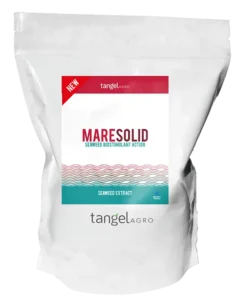
Ascophyllum nodosum seaweed biostimulant with humic and fulvic acids and free amino acids for rooting, vigor, yield, …

Rooting biostimulant with IBA, amino acids, fulvic acids and organic matter for early establishment, stronger roots a…

Vegetable-origin liquid humic and fulvic acid biostimulant that supports germination, root development, nutrient avai…
Interested in this product? Contact our team for technical information, availability, application guidance, quotations or distribution opportunities.
Use this form for: