Product Type
Calcium silicate fertilizer

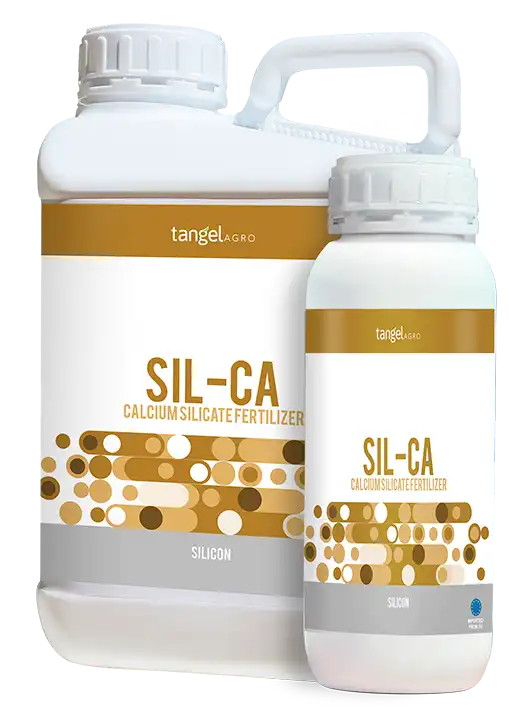
SIL CA is a calcium silicate fertilizer for foliar and soil application. It is designed to fortify plant tissues and support crop resistance to physical damage throughout the crop cycle.
The formulation supplies silicon and calcium. The source links silicon deposition in epidermal tissues with stronger plant structure, improved light capture, nutrient uptake, tolerance to environmental stress and post-harvest performance, while calcium is described as important from germination through fruit ripening and for stronger vegetal tissues.
Key product information at a glance.
| Composition | % w/v |
|---|---|
| Silicon (SiO₃) — notation as printed in source | 24.00 |
| Calcium (Ca) | 15.00 |
SIL CA combines silicon and calcium in a calcium silicate fertilizer for both foliar and soil use. The source states that silicon deposition in epidermal tissues increases mechanical stability and provides a physical barrier to pathogens and insects.
The document also links silicon nutrition with improved uptake of nitrogen, phosphorus, potassium and micronutrients; lower transpiration under drought and heat; reduced sodium uptake under salinity; and regulation of plant uptake under heavy-metal stress. Silicon is also described as associating with cell-wall proteins in post-harvest tissues.
Application Guidance: Use only the crop- and method-specific doses stated in the application table. The supplied technical document does not specify application timing, treatment frequency, water volume or a general universal dose.
| Crops | Timing | Dose | Notes |
|---|---|---|---|
| Garlic and onion | Not stated in source | 5-10 L/ha/application | Soil dose reproduced from the crop table. |
| Berries | Not stated in source | 7-15 L/ha/application | Soil dose reproduced from the crop table. |
| Crucifers | Not stated in source | 5-10 L/ha/application | Soil dose reproduced from the crop table. |
| Cucurbitaceae | Not stated in source | 5-10 L/ha/application | Soil dose reproduced from the crop table. |
| Gramineae | Not stated in source | 5-10 L/ha/application | Soil dose reproduced from the crop table. |
| Ornamental crops | Not stated in source | 7-15 L/ha/application | Soil dose reproduced from the crop table. |
| Papaya | Not stated in source | 5-10 L/ha/application | Soil dose reproduced from the crop table. |
| Grass | Not stated in source | 10-40 L/ha/application | Soil dose reproduced from the crop table. |
| Solanaceous crops | Not stated in source | 5-10 L/ha/application | Soil dose reproduced from the crop table. |
| Carrot | Not stated in source | 5-10 L/ha/application | Soil dose reproduced from the crop table. |
| Crops | Timing | Dose | Notes |
|---|---|---|---|
| Garlic and onion | Not stated in source | 1-4 L/ha/application | Foliar dose reproduced from the crop table. |
| Banana | Not stated in source | 0.5-1 L/ha/application | Foliar dose reproduced from the crop table. |
| Berries | Not stated in source | 1-4 L/ha/application | Foliar dose reproduced from the crop table. |
| Crucifers | Not stated in source | 1-3 L/ha/application | Foliar dose reproduced from the crop table. |
| Cucurbitaceae | Not stated in source | 1-4 L/ha/application | Foliar dose reproduced from the crop table. |
| Fruit trees | Not stated in source | 2-4 L/ha/application | Foliar dose reproduced from the crop table. |
| Gramineae | Not stated in source | 1-4 L/ha/application | Foliar dose reproduced from the crop table. |
| Lettuce | Not stated in source | 1-4 L/ha/application | Foliar dose reproduced from the crop table. |
| Legumes | Not stated in source | 2-6 L/ha/application | Foliar dose reproduced from the crop table. |
| Ornamental crops | Not stated in source | 1-6 L/ha/application | Foliar dose reproduced from the crop table. |
| Solanaceous crops | Not stated in source | 1-4 L/ha/application | Foliar dose reproduced from the crop table. |
| Carrot | Not stated in source | 1-3 L/ha/application | Foliar dose reproduced from the crop table. |
SIL CA is intended for silicon and calcium nutrition where stronger plant tissues and improved structural resilience are required. The source also positions it for lodging reduction, environmental-stress support, nutrient uptake and post-harvest performance.
SIL CA is a calcium silicate fertilizer for foliar and soil application.
The source lists 24% silicon, printed as SiO₃, and 15% calcium on a % w/v basis. It also gives a density of 1.40 and pH of 7.8.
It is used to fortify plant tissues and support structural resistance, nutrient uptake, environmental-stress tolerance and post-harvest performance.
The source states that silicon accumulates in epidermal tissues, increasing mechanical stability and helping reduce lodging incidence.
Yes. The document states that silicon deposition can reduce transpiration rates and support crops under drought and heat stress.
Yes. The source states that silicon can help reduce salt stress by inhibiting sodium uptake.
The source specifically mentions nitrogen, phosphorus, potassium and micronutrients.
Yes. The datasheet provides soil rates for garlic and onion, berries, crucifers, cucurbitaceae, gramineae, ornamentals, papaya, grass, solanaceous crops and carrot.
Yes. Foliar rates are provided for garlic and onion, banana, berries, crucifers, cucurbitaceae, fruit trees, gramineae, lettuce, legumes, ornamentals, solanaceous crops and carrot.
The documented fruit-tree foliar dose is 2-4 L/ha per application.
The documented grass soil dose is 10-40 L/ha per application.
SIL CA is available in 1 L, 5 L, 10 L, 20 L and 1000 L formats.

Calcium-magnesium silicate fertilizer for stronger tissues, calcium nutrition, photosynthetic support, stress resilie…

Organic Ca-Mg-B-Si nutrient corrector for firmer tissues, calcium mobility, flowering, fruit set, pollen quality and …

Micronized calcium carbonate and silicon solar protector for crops, helping reduce sunburn, UV exposure, thermal stre…
Silicon and potassium nutrient corrector with plant amino acids for rapid uptake, abiotic-stress support, root develo…
Interested in this product? Contact our team for technical information, availability, application guidance, quotations or distribution opportunities.
Use this form for: